


The implementation of Technology Enabled Care within 3 local authorities across the West Midlands to support adults with mobility issues.
What is the problem to be solved?
As part of this programme, WM5G were responsible for commissioning and delivering a 1-year Technology Enabled Care (TEC) scalable proof of concept in adult social care and being delivered in partnership with City of Wolverhampton Council (CWC), Birmingham City Council (BCC) and Coventry City Council (CCC). This follows a successful regional bid for funding to explore and gather evidence of benefits of impact for TEC recipients, the local health and care system and the wider region of deploying digital care technology combined with 5G standard connectivity to improve the independence and outcomes for older adults.
In the UK, roughly 7.6 million adults experience mobility issues. This represents a significant portion of the disabled population of 16.8 million, with mobility impairments being the most prevalent type of disability. With growing demand for person-centred care at home, Technology Enabled Support is becoming increasingly important to help vulnerable citizens maintain their independence while ensuring peace of mind for families and carers.
Many adults face mobility issues due to conditions like arthritis, stroke, or injury. These problems can make walking, climbing stairs, or using public transport difficult. For example, someone with severe arthritis may need a walking aid or struggle to move around their house on a day-to-day basis without aid.
This case study highlights the challenge of balancing supportive care with the preservation of personal independence. The solution involved identifying and deploying technology that could assist with daily living such as medication reminders and mobility support without becoming overly intrusive or fostering dependency. In doing so, it maintained the dignity of the citizen while empowering them to live safely at home.
A further consideration was privacy. The solution had to allow family members to remain informed of the citizen’s condition and well-being without breaching their personal boundaries. To address this, technology was selected that provided non-invasive remote monitoring, offering reassurance to loved ones while respecting the individual’s right to privacy.
However, there were barriers to adoption. One was the limited availability of tailored technology that could be deployed quickly, cost effectively, and matched to the specific needs of the citizen. Another was the citizen’s own resistance to change and unfamiliar systems. To mitigate this, technology with a simple, intuitive interface was chosen, in order to demonstrate its benefits and ease of use. Clear communication and training helped ensure that the technology was accepted and used effectively by both the citizen and their family.
Local authorities are beginning to shift their mindset by embracing technology as a key solution across their organisations. This change allows for more efficient service delivery, better data management, and improved accessibility for citizens. From using digital platforms for social care to implementing smart mobility solutions, councils are recognising the value of technology in addressing long-standing challenges and improving outcomes for communities.
West Midlands 5G : Accelerating the benefits of 5G

Homepage | City Of Wolverhampton Council

Birmingham City Council Homepage


What is the solution to the problem?
Between September 2024 to June 2025, WM5G Ltd delivered a Technology Enabled Care (TEC) pilot programme, partnering with 3 West Midland Local Authorities and sector suppliers, to support 650 citizens that were in receipt of adult social care (ASC). The initiative aimed to enhance care outcomes and demonstrate the cost-effectiveness of TEC at local and programme level. Social workers in ASC teams identified citizens who might benefit from TEC and referred them for personalised technology solutions. These were selected, installed and a data portal provided through a fully managed care technology service provided by Alcove LTD
A typical solution deployed was a video-enabled mobility support device, allowing individuals with limited mobility to stay visually connected with family through simple video calls. This helped families check in regularly, offer emotional support, and monitor wellbeing, all while reducing feelings of isolation and promoting independence for the user. This device can also be connected to a Ring Doorbell, allowing the citizen to answer the door remotely, without having to travel to and from the front door and increasing the likelihood of a fall.
Another piece of technology utilised was a falls detection watch. In the event of a fall, this device sends immediate alerts to carers and family members. Sensors around the home can also be utilised to identify changes in activity and behaviour. This ensures timely intervention and reduces the need for constant physical supervision. It provides an important layer of safety while continuing to support the citizen’s independence.
The technology supplier was responsible for monitoring the data collected from sensors, smart watches, and other remote monitoring devices and passing this information along to the monitoring services, which will then follow the required process necessary to provide the help required. These devices connected wirelessly through the citizen’s home Wi-Fi or via a mobile network 4G/5G SIM card, allowing the supplier, family members and carers to track key information in real time via text messages or alerts, identifying any concerns, and ensure timely responses when needed.
Once a Social Worker makes a referral and the Digital Navigator selects the appropriate technology, an installation is arranged with the citizen. The role of the Digital Navigator is to select the equipment that will give the best benefit to the citizen based off their situation. For standard referrals, installation occurs within 5 working days; for urgent cases, within 48 hours. After setup, the installer tests the devices, provides a demonstration, and hands over user guides to the citizen and their family.

Figure 1 - Falls Detection Watch
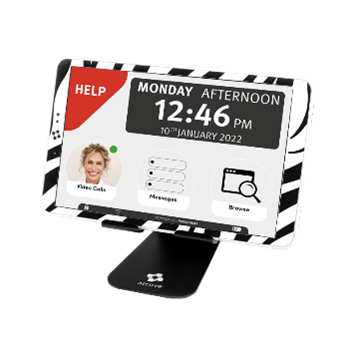
Figure 2 - Alcove Video Carephone
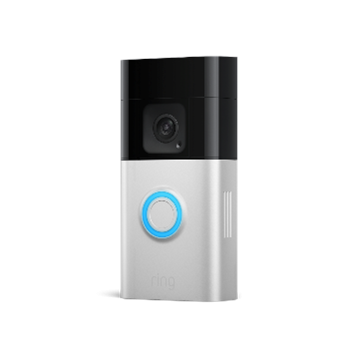
Figure 3 - Ring Doorbell
Commercial model (Business Case)
Cost and benefit modelling has been carried out at a programme wide level considering multiple case studies for different conditions and different devices. Hence below is not specific to mobility issues but is relevant to the whole TEC programme. Technology enabled care becomes viable when multiple stacked use cases are being delivered across a wide population of citizens.
The market for Technology Enabled Care is still ever evolving. Service offerings from suppliers differ greatly in their scope, complexity and price. It was key for this project to procure a fully managed service across 3 Local Authorities to test and prove whether TEC could be rolled out and delivered at scale. Through a competitive procurement process, we selected the most complete managed service solution available at that time.
Over a period of 12 months, TEC costs on average around £2,000 per person, but includes all installation, devices, platform, SIM, Licences, maintenance, monitoring, response and virtual care calls.
Utilising an independent evaluation partner, the project was able to establish three areas of potential savings. The evaluation was carried between Rethink Partners LTD and the Local Authorities to ensure consistent and reliable evidence was utilised, whilst modelling the benefits, lower end expectations were used when calculating the ROI.
These were primarily driven through:
Delay: The need for home care where there is an increase in service for new or existing support plan by deploying TEC; amounting for 83% of savings
Prevention: No care plan or social care needs; amounting for 14% of savings
Reduction: Reduce the level of home care package that they have received by blending TEC; amounting for 3% of savings
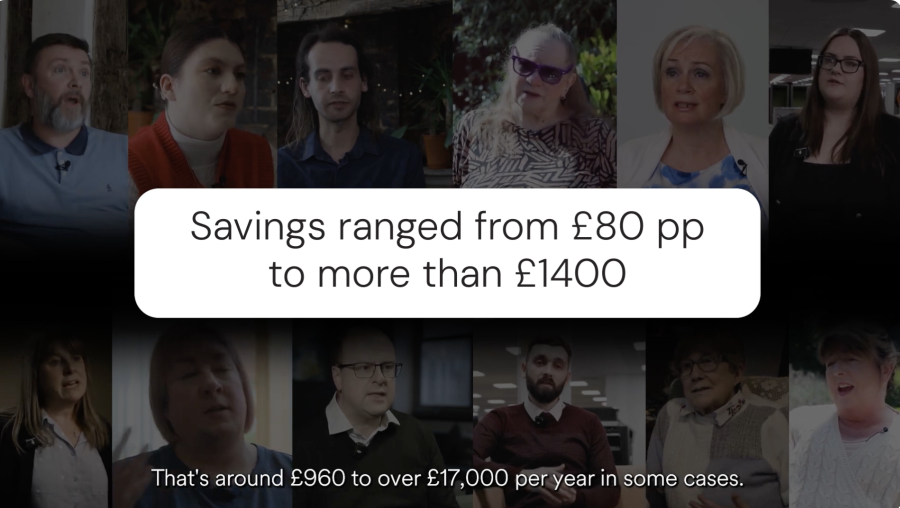
Across the programme, care technology has delivered a range of significant benefits including a return on investment of £1.7 – £1.8 for every £1 spent, highlighting the strong economic value and efficiency of the initiative.
Overall, the evaluation supports a strong case for broader TEC adoption across adult social care, with the potential to deliver improved outcomes, enhanced efficiency, and cost savings at scale.
Rethink Partners: Culture change and adoption specialists
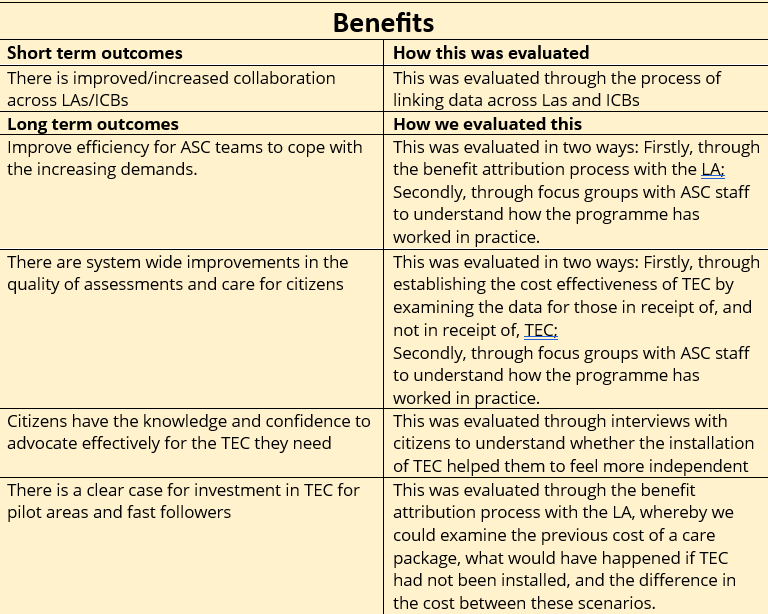
Benefits
The implementation of technology enabled care (TEC) in adult social care has demonstrated significant benefits, including cost savings, enhanced independence, improved health outcomes, reduced social isolation, and more informed decision making, all of which contribute to better quality of life and more sustainable care models for mobility impaired adults.
Cost Savings: TEC reduces the need for in-person care and high-cost interventions, such as hospital admissions as citizens can be monitored remotely by their friends and family. Care technology has delivered a range of significant benefits including a return on investment of £1.7 – £1.8 for every £1 spent to the West Midlands Local Authorities.
Improved Independence: TEC enables citizens to remain independent at home for longer. Remote monitoring technologies (e.g. fall detectors) allow early intervention, reducing the need for residential and hospital care.
Better Health Outcomes: TEC, through digital tools and remote patient monitoring, facilitates early detection of health deterioration, reducing hospital admissions and emergency interventions.
Reduced Social Isolation: Social technologies, such as video communication tools and virtual companionship platforms, have been shown to reduce social isolation among elderly citizens, improving overall mental health
Improved Decision-Making: TEC provides social workers with real-time data on service users’ activity levels, allowing for proactive, data-driven decision-making. Research from NHSE demonstrated that TEC allowed social workers to make informed, proactive decisions based on data collection from service users.
Lessons Learnt
The introduction of technology enabled care (TEC) solutions required thoughtful planning, effective team engagement, and a strong foundation in change management. Key lessons emerged from the implementation process that can guide future programmes:
Accessibility Comes First: Technology must be designed with accessibility in mind, ensuring that individuals with mobility challenges can use it independently without unnecessary barriers.
Feedback Loops Drive Improvement: Continuous input from citizens with mobility issues allows for iterative updates, ensuring the technology evolves with their needs.
Integration with Daily Life: Technology implemented should seamlessly fit into existing routines, whether at home, work, or in public spaces, rather than requiring disruptive changes.
Prioritise Face to Face Training for Maximum Impact: In person training sessions proved to be the most effective for engaging teams and building confidence in using TEC solutions. They allowed for meaningful dialogue, hands-on demonstrations, and stronger knowledge retention among the social workers.
Initiate Training Early with a Structured Onboarding Plan: Training should begin before the service launch. Establishing a clear, detailed plan for the first three months, including key training events, onboarding materials, and user support and ensuring smoother adoption.
Consistent Communication Across Stakeholders: By enabling clear and consistent communication between stakeholders, blockers can be easily identified and managed. Shared learning can also be applied to allow a more streamlined process
If you’re ready to embark on a connectivity project, we can point you to the suppliers with expertise in your sector.