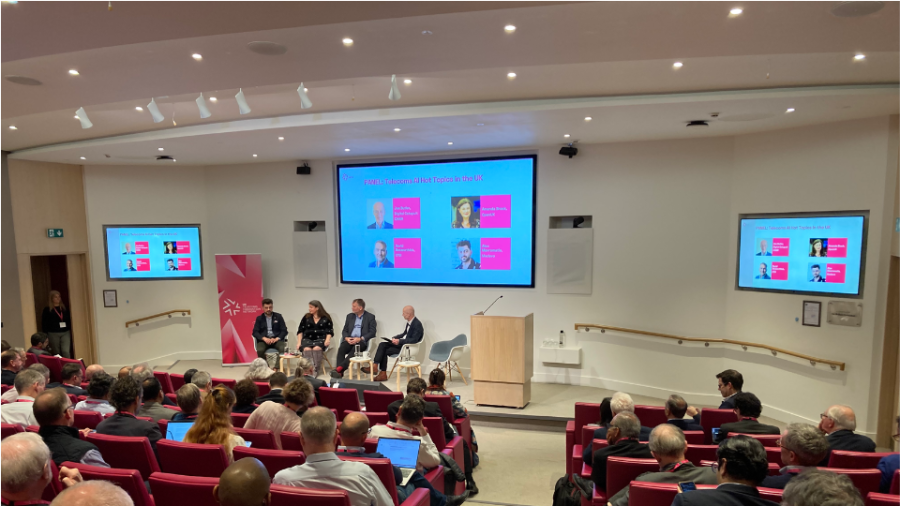
On 15th January, Digital Catapult and University of Bristol brought together over 140 people from across the telecoms and AI sectors to share the latest insights, challenges, research and innovation being undertaken in this exciting space.
With viewpoints from data centre infrastructure, telecoms industry, investors and research organisations this event, delivered by Cambridge Wireless, proved to be a fitting end to UKTIN’s events programme, with a particular focus on work happening across the UK and the specific role to be played by the UK in this global industry.
The day explored how we build an AI native telecoms ecosystem in the UK, and what that looks like in practice, not just in principle. A number of key themes emerged across the sessions, and here we share our highlights.
Collaboration is King
From Head of UKTIN, Ian Smith’s opening speech to the final thoughts of the day, one thing came through loud and clear: no organisation, sector or country can go it alone when it comes to AI.
“Collaboration is a strategic necessity” said Smith, “we can’t just have innovation.” He went on to explain that effective collaboration lowers the cost of innovation, helps align incentives between policy and market, builds trust and more. Imen Grida Ben Yahia, Principal AI Scientist at AWS echoed this, explaining that the ecosystem is “super diversifised” with different dimensions across data, models, how things are used, the different applications and hardware. Where everything is naturally distributed and there is a need for global consensus, Dimitra Simeonidou, Director of the Smart Internet Lab, University of Bristol, shared her views on how the need for collaboration spans internationally. “I really believe collaboration can happen at different levels” she said, “but collaborating over platforms on real problems, brings communities together globally.”
Dan Kilper, Professor of Future Communication Networks, Trinity College Dublin and Director, CONNECT Centre, explained that as we move into making networks AI native, we’re really operationalising and coming up with new ways to create and operate networks. “That means bringing together the entire community” he stated, “you can’t do this in isolation. We need to work together across national boundaries.”
Smith offered some specifics around how that collaboration should manifest itself, through shared language and approaches to data access, neutral convening places, continuous dialogue and organisations – like UKTIN – that can sit between sectors not within them. He made an impassioned pitch for collaboration to be viewed as a strategic asset which felt like the central tenet for the day.
The rediscovery of AI
In her keynote, Imen Grida Ben Yahia, shared that she has been working in the AI space for 15 years and that AI has been real for years but not adopted properly. With the GenAI period, there has been a rediscovery of AI as people’s eyes have been opened to what is possible.
Grida Ben Yahia shared that the most common use cases they’re seeing in the telco sector focus on network digital twins for what-if scenarios, and network observability enriched with anomaly detection, KPI forecasting, other capabilities.
Introducing a topic that was discussed throughout the day, was a sense that we’re perhaps seeing a rise in small models, stating that not everything requires an LLM. This was echoed by Simon Rowell, Senior Vice President, Nscale, who stated that they expect the growth of small language models to be the “next big wave” we’re going to see, and the resulting specialisation.
Indeed, there was a sense that most important is not large or small models, but specialised, where models are training based on the different data you have, the ecosystem, and the dynamic nature of AI where reinforcement learning is a constant requirement.
Are we in a bubble?
In a fascinating presentation from David Pollington, Technology Consultant, the audience learned how AI is becoming better, cheaper, faster and easier to deploy with inference costs reduced 5-10-fold per annum, resulting in rapid advancements in performance / $.
Enterprise AI has exploded as a marketplace: valued at up to $37bn, it is the largest category in history in terms of growth rate. Yet enterprise adoption is a mixed picture, with few organisations deploying across the breadth of the company and even fewer enterprise AI systems delivering significant returns.
The inevitable question therefore is: are we in an AI bubble?
Simon Rowell, Nscale addressed this head on, stating that “There are common themes in the market: efficiency, automation, productivity. Those aren’t going away over the long term and are common throughout the world. There’s a lot of cost pressure in a lot of areas and AI is seen as one of the solutions that can help that.” He made a convincing argument for AI being in a super cycle, similar to that we saw with the internet and the dotcom boom / downturn, which arguably still continues today. “The tech and infrastructure might change, the GPUs are constantly evolving: he said, “but I think we’re in a long-term cycle and the gains are going to be exceptionally large.”
Pollington shared a similar sentiment, noting that we’re at the beginning of the industrial age of AI where the long-term impact will profound. He noted that telcos see a lot of benefit and opportunity to monetise AI, with McKinsey estimating the value to the telecoms sector as $35-70bn by 2030.
The big question therefore is not so much are we in an AI bubble, but can telcos really execute on the AI opportunity?
Navigating AI in Critical National Infrastructure
It was identified early on in the day that one of the challenges with deploying AI in telecoms is that we’re dealing with critical national infrastructure and therefore security is a prominent concern.
While Yue Wang, Chief Technologist, China Telecom, felt strongly that concerns over security shouldn’t be a blocker to adoption, Alex Healing, Distinguished Engineer and Research Principal, BT, took a slightly more cautious tone, stating that the embedding and proliferation of AI was undoubtedly expanding the attack surface and lowering the skills gap for sophisticated attacks to be carried out.
He noted however that BT are focusing their AI attentions on both intelligent operations and cybersecurity. They are researching how they can leverage AI to understand these nascent threats on the horizon, and modelling simulation techniques to understand how to better identify and respond to attacks.
Simon Rowell and Imen Grida Ben Yahia also saw AI as a key tool for threat detection, stating that there are already tools in production from the research domain. There was interesting discussion about the concept of guardrail policies to constrain your model to only undertake actions you have governed.
Referring back to the concept of reinforcement learning that Grida Ben Yahia introduced in her keynote, a question from the audience asked how this is possible in a live network. The answer? Digital twins which are a true real-time emulation of your network. There was a sense that there are still gaps to plug in this regard, but that was a trend AWS was seeing.
While security was undoubtedly a hot and involved topic, there was a sense that marrying autonomous networks with cybersecurity, driven by AI, could help to address some of the challenges AI can give rise to.
The phenomenal pace of change
The last UKTIN conference on AI was two years ago and it was commented on multiple times throughout the day, how much things had changed in that time.
The cycle and pace of change is phenomenal and is unlikely to slow down any time soon. Grida Ben Yahia shared that sitting between the two worlds of telecoms and AI, she sees how quickly things are changing. She reflected on the fact that she sees papers being published and then within a space of weeks you see things emerging in open source. “The cycle is so fast now” she remarked, with industry paying a lot more attention to things as they emerge.
So how can telcos navigate this space against that backdrop of rapid shift and change? “We are building to support what comes next” said Yue Wang, noting that infrastructure must be flexible, and adaptable enough to support future services. Adaptability was certainly the emerging theme here, with Alex Healing sharing that as a telco, BT needs to think about how they can build adaptive systems that are flexible as AI techniques evolve.
Healing also noted that there is an imperative for telcos to be sufficiently educated to consume what is happening in AI development, and distinguish between hype and reality, especially when things are happening so quickly. “Don’t get too wrapped up in techniques” he advised, “focus on what the experience you want to enable is, with the agility to swap out techniques later when you want or need.”
Openness vs Standards
The pace of change was a prominent topic when discussions turned to standards. Amanda Brock, CEO, OpenUK, noted that this is going to continue and we’re going to see “continuous iteration, refinement and building.”
Against this backdrop, is there a chance that standards can keep up? David Bosworthick, Director of Strategy and Innovation, ETSI, noted that ETSI has shifted significantly over the past seven years. “We’re no longer talking about standards” he stated, “we’re talking about standards supported by living code. We have standards moving at a faster speed and collaborative code being produced to prove those standard cycles.”
There was a recognition that standarisation needed to evolve to survive and remain relevant. “Standardisation needs to be lighter, faster, more adaptive, include much more code and respect different worlds” claimed Bosworthick. Brock echoed this, cautioning against creating standards that are too specific to telco, unless it’s a telco issue, as there will be inevitable interaction with other sectors.
“We’re not going to standardise LLMs or algorithms” Bosworthick stated. Instead, he shared that their focus was on security, guardrail frameworks and quality of data.
Alongside the discussion on standards was the prevalence of open source in AI. Openness is driving innovation Brock stated, and is important in terms of transparency, testing and safety.
Alex Mavromatis, Co-founder and CEO, Madevo, recognised that “openness is key for innovation in start-ups”, noting that start-ups can’t compete with big companies in terms of building models but that they can create unique value propositioning by adding value on top of and around the smaller models that are open source.
UK Showcase
When it comes to AI, Ian Smith made it clear at the start of the day that the UK starts from a position of strength: strong foundations in AI safety, ethics and regulation, alongside academic excellence and deep sectoral expertise. Part of the event we particularly enjoyed therefore was the showcase, which shone a light on UK organisations demonstrating AI prowess on the world stage and clarified the primacy of groups of research, activity and innovation happening across the UK.
These included:
- JOINER: Dimitra Simeonidou introduced the audience to JOINER, the national scale experimentation platform for advanced communications and specifically the AI Acceleration Facility. She shared how the facility will be benchmarking and getting answers to how networks can enable AI, and plans to develop an AI Deployment Assessment Framework to build trust and traceability from the data to the model to the deployment.
- Opening the telecom AI black box: Dritan Kaleshi, Director of Future Networks and Digital Infrastructure, Digital Catapult, stated that if we don’t evolve our test, measure and verification capabilities we risk creating AI native networks that are innovative but increasingly opaque and not trusted. Digital Catapult and Ofcom have conducted a significant study, which will be published shortly, which found that there is no unified end-to-end AI test and verification framework today. Kaleshi made the case that ensuring we can test and verify AI native networks is essential and a space where the UK can take initiative.
- CHEDDAR: Julie McCann, Co-Director of Space, Security and Telecoms, Imperial College London explained how AI is central to CHEDDAR, where 25% of their people are AI experts pulled in from top universities across the UK. McCann shared how CHEDDAR’s vision is that by 2035 we won’t just be shipping data across our networks but providing services such as joint sensing – just not possible without AI, over the air compute, and using energy from network to power up battery free devices.
- TITAN: Harald Hass, Van Eck Professor of Engineering, University of Cambridge, introduced TITAN and their vision for ubiquitous connectivity, built in a reliable, trustworthy and high performing fashion, including self-configurability and self-healing. TITAN features six lighthouse projects and Hass explained how AI was a cross-cutting theme across all of these. He shared examples of work encompassing AI, such as providing more resilient coverage in dynamic weather conditions, such as fog.
- AI in spectrum management: Dominic O’Brien, Professor of Engineering Science, University of Oxford, and Simon Saunders, Independent Telecoms Advisor, jointly presented on the work being done in JOINER and HASC on spectrum management, harnessing AI. JOINER has developed the JOINER National Spectrum Facility for spectrum management and innovation, which can be used for monitoring, emulating, assigning, replaying, collaborating and training. HASC, which now has 19 university partners, works to use AI in various physical demonstrations and AI related work that relates to spectrum, specifically for resource optimisation and intelligent spectrum sharing.
Overall the event proved to be thought provoking, informative and engaging. It’s clear that AI is here to stay, and the challenge is set for the telecoms sector to fully realise its potential.