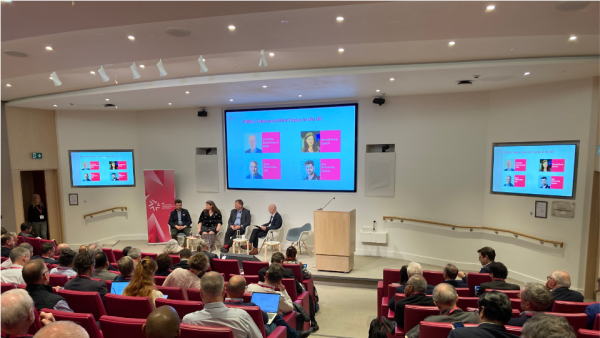
On December 2nd at the Tobacco Dock in London, UKTIN and DSIT hosted an exclusive showcase highlighting the lasting impact and legacy of the Future Network Programmes, with a spotlight on creating sustainable business and funding models.
Dritan Kaleshi, UKTIN Lead for Future Telecoms Capability, opened the event by explaining that the government’s digital infrastructure and network initiatives are facing “a pivotal moment”, and emphasising the need for an intimate, thoughtful, strategic gathering to discuss the next steps for those working in the telecoms sector.
Ian Smith, Head of UKTIN, highlighted the profound impact the network has had on shaping the direction, ambition and capability of the UK’s telecoms sector, noting that it has united the telecoms ecosystem, accelerated innovation, and strengthened the UK’s long-term competitiveness. UKTIN, he said, has helped to “reshape the environment in which UK telecoms innovation takes place” across industry, academia, policy, investment and skills, ultimately forming a crucial foundation that will serve the UK long after the programme formally ends.
Sector Snapshots
A range of expert panellists discussed the realities of driving technological change, analysing the opportunities, the roadblocks, and the lessons learned.
Ports:
Mike Dawson, People & Digital Transformation Director, Belfast Harbour, commented: “We’ve been on a real journey to harness 5G-led innovations to accelerate the digitisation of port operations, and we have a proof of concept with BT. However, we now need to deliver something sustainable in the long term — this isn’t about deploying technology for its own sake. Early on, we brought tenants into the equation, and now, they are believers. We’re focusing on the needs of small local companies in Belfast. If we can prove a use case at the harbour, we can prove it elsewhere too.”
Fasih UlHaq, Business Analyst, Port of Tyne, added: “We see 5G as an enabling technology to improve operations and maintenance at the Port, and as more and more use cases have developed, the value of the 5G network has become increasingly palpable. However, on reflection, I do think we started haphazardly, and we would choose different use cases now; a roadmap is important.”
Adult Social Care:
Jill O’Boyle, TEC Service Manager, NHS Lanarkshire: “Everybody knows the pressure and demands on social care staff, and so transitioning from analogue to digital care is very much needed. We are not trying to save money. We are trying to free up demand! The system is really struggling. But we are only at the beginning of our journey, and there is so much more to be done. We are very risk-averse in health and social care, and so have taken things very slowly, which is why it’s taking us a while to scale up. The technology is the easy bit — the people, the processes, and the culture are the difficult part. Nobody should underestimate that. Technology-enabled care needs to be thoroughly planned.”
Rachael Murphy, Deputy Director of Adult Social Care, City of Wolverhampton Council said: “We believe technology can make a difference to people’s lives. We want to move away from reactive care where we can, and approach health and social care differently. External funding has enabled us to improve our tech offer and pilot use cases. Our team really seized on this opportunity, and we are just about to award a 5G contract in Wolverhampton. Yet financial restraints are a real challenge for local authorities. 5G technology will hopefully reduce demand going forward, but it’s not always a quick win. You have to be bold and brave to succeed in tech-enabled healthcare.”
Transport:
Sam Li, Senior Innovation Officer, Transport for Greater Manchester, said: “We have built incredible opportunities from the 5GIR programme, which focused on decarbonisation and included transportation. Our whole premise is to deliver more for less, and we are on our way to achieving that. But you can’t just build your way out of a problem. I suggest people look at strategic corridors. Don’t try to do everything! Choose a starting point and give it your entire focus. Take the time to think about the right approach — we’re actually beginning to look at satellite communications and the role they could play in our long-term goals for the city of Manchester, something we never considered initially.”
Barney Smith, Founder and CEO, Perform Green, continued: “We’re using 5G to improve lorry journey times and facilitate autonomous logistics. We are also looking at deploying a private 5G network along a bus route, which is exciting. My advice is to follow the money. For example, who is the beneficiary of improved bus journey times? If the people running the buses aren’t, they might be less motivated. You need to remember that.”
Rural:
James Standen, Farms Director, Newcastle University Farms, said: “Previously, we were spending a lot on fertiliser, most of which was nitrogen. The 5G-enabled sensor can accurately determine the nitrogen availability in the grain, thereby increasing efficiency. It has been revolutionary. I am saving time and money, and the planet!”
Neave Anderson, Digital Innovation Farm & Agri-Tech Project & Industry
Engagement Manager, Hartpury University added: “Implementing technology on farms is very difficult because of the demographic; the average age of a farmer is 65. One of the restricting factors is the private 5G network — to utilise it, we have to apply for an Ofcom license, which is limiting and costly. It is a major challenge. However, 5G technology has helped our farm to be robust. The major success is the advanced wireless connectivity trailer. We have shown farmers through the 5GIR programme that if they improve connectivity, they can drive productivity.”
Additional sessions featured telecom suppliers reflecting on how they have crafted compelling offers and evolved through their involvement in the DSIT-funded programmes, as well as a discussion that spotlighted collaborative R&D projects from the Open Networks Programme, highlighting how companies, industry partners, and local authorities have worked together to develop and deploy sustainable digital infrastructure solutions.
Attendees were also informed about the seismic shift in UKRI funding. Professor and technologist John Goodacre, Director at Innovate UK, explained that the organisation’s grants will be divided more strategically and centred on outcomes. “We need to scale up to things that people will actually buy,” he said, “The hope is that we can optimise the system and remove bureaucratic processing. We need to focus on the input to get that output moving.”
The day concluded with networking and an exhibition, and a closing statement from Kaleshi: “Funding from the UK government has created a vision for the future of telecoms, but the programme has been delivered by people trying to solve real-world problems. Let’s consider UKTIN and the Future Networks Programmes as a launchpad for telecoms innovation. You have all done such a brilliant job.”